
Mixture of Experts (MoE) Configuration#
This document provides a detailed explanation of the configuration parameters related to Mixture of Experts (MoE) models in MaxText. These settings control the model architecture, routing mechanisms, and performance optimizations. Default values and parameter definitions are located in src/maxtext/configs/base.yml and are primarily used in src/maxtext/layers/moe.py.
1. Architecture#
MoE Strategy#
MaxText supports both Dropless and Dropping strategies. Please refer to the decision tree below to determine the active strategy.
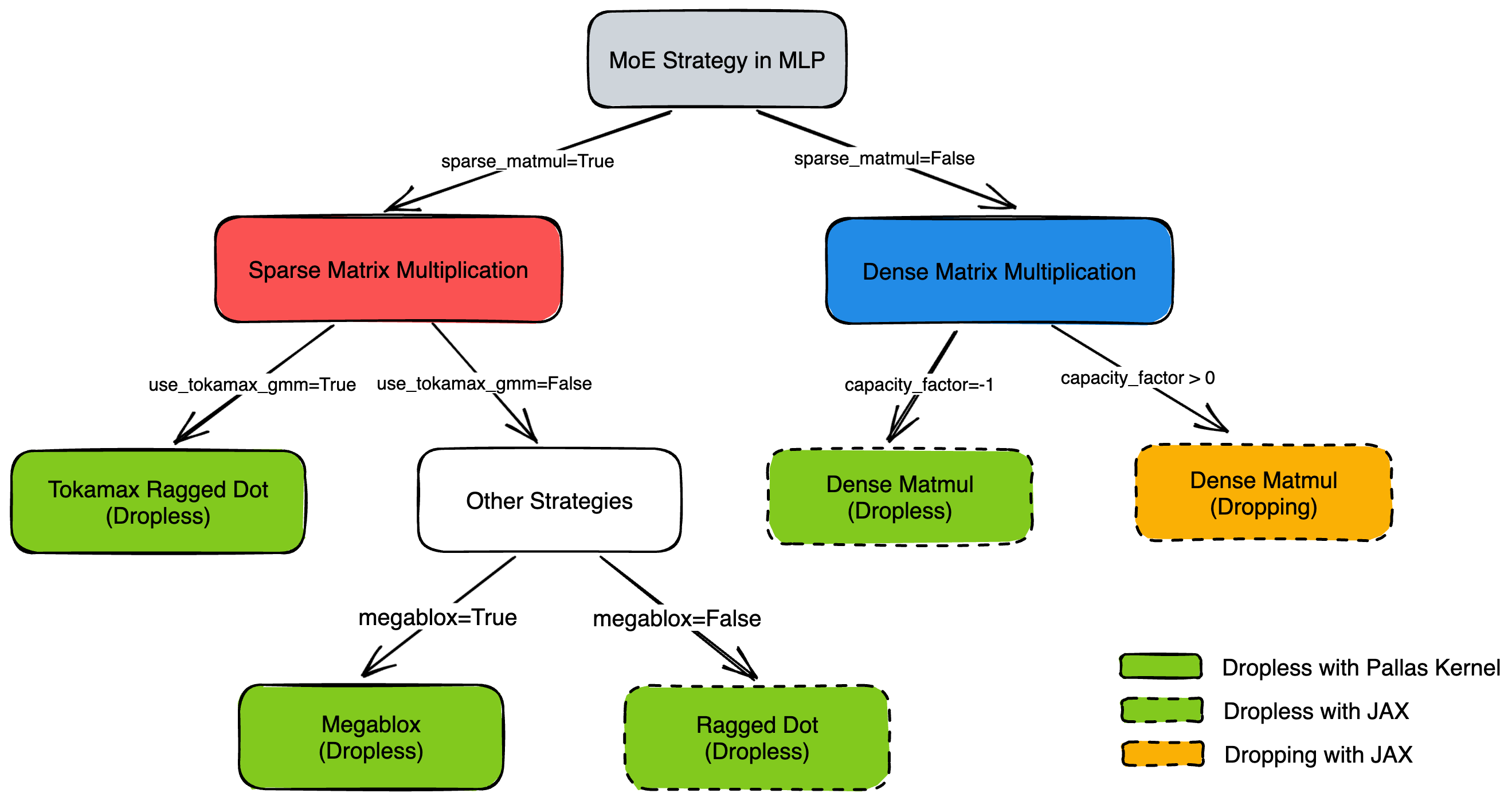 Figure 1: Decision Logic for MaxText MoE Strategies.
Dropless:
Tokamax Ragged Dot: Enabled by setting
sparse_matmul=True, use_tokamax_gmm=True.Megablox: Enabled by setting
sparse_matmul=True, use_tokamax_gmm=False, megablox=True.JAX Ragged Dot: Enabled by setting
sparse_matmul=True, use_tokamax_gmm=False, megablox=False.Dense Matmul: Enabled by setting
sparse_matmul=False, capacity_factor=-1.
Dropping:
Dense Matmul: Enabled by setting
sparse_matmul=False, capacity_factor > 0(commonly 1.0 to 1.25).
General Configuration#
num_experts: The total number of routed experts available in the MoE layer.
num_experts_per_tok: The number of experts selected for each token, often referred to as top-k strategy.
shared_experts: The number of experts that are always active for every token, in addition to the routed experts.
base_moe_mlp_dim: The intermediate dimension size for the MLP blocks within the experts.
interleave_moe_layer_step: Defines the frequency of MoE layers in transformers. If set to 1, every layer is an MoE layer. If set to X, an MoE layer appears every X layers.
first_num_dense_layers: The number of initial dense layers before the first MoE layer is introduced.
float32_weight_sum: If enabled, performs the summation of expert weights using float32 precision for improved numerical stability. Recommended specifically when lower precision types cause convergence or quality issues.
Routing Mechanism#
use_random_routing: If enabled, ignores the gate logits and routes tokens to random experts. This is designed to simulate load balancing for debugging and performance testing purposes.
n_routing_groups and topk_routing_group: Experts are divided into n_routing_groups. The router first selects the top k highest-scoring groups (as topk_routing_group), and then selects experts only from those groups.
routed_bias: If enabled, adds a learnable bias term to the gate logits to facilitate load balancing.
routed_bias_update_rate: Defines the update rate to routed bias term above. Applicable only to the DeepSeek decoder block.
routed_score_func: Defines the scoring function for the router.
routed_scaling_factor: A scalar multiplier applied to the expert weights.
load_balance_loss_weight: Sets the coefficient for the auxiliary loss term used to encourage balanced token distribution among experts.
norm_topk_prob: If enabled, normalizes the router weights for the selected top-k experts.
MLP Block & Computation#
sparse_matmul: Determines whether to use efficient sparse matrix multiplication or dense matrix multiplication.
True: Uses specialized kernels (like Tokamax Ragged Dot or Megablox) or JAX Ragged Dot to perform computation only on active tokens. This is generally faster for MoE.False: Performs dense computation with masking. This is typically used when checking numerical correctness or implementing dropping strategies.
use_tokamax_gmm: If enabled, use Tokamax library’s Ragged Dot for matmul. Recommended for dropless configurations.
megablox: If enabled, use Megablox for sparse matrix operations. Effective only when use_tokamax_gmm is False.
capacity_factor: A scalar multiplier for expert capacity. Effective only when sparse_matmul is False.
Value > 0: Enforces a strict capacity limit; tokens exceeding this limit are dropped.
Value = -1: Dropless with dense matrix multiplication, which is computationally expensive and typically used only as a baseline.
ragged_buffer_factor: A scalar multiplier for the size of the ragged buffer (effectively expert capacity). Effective only when sparse_matmul is True.
Value > 0: Uses an explicit buffer size which may drop tokens when this size is exceeded
Value = -1: Uses a worst case calculated buffer size which is guaranteed to not drop any tokens.
use_custom_sort_vjp: If enabled, use a custom Vector-Jacobian Product (VJP) sort for efficient backward pass processing in sparse matmul. Recommended to replace the inefficient scatter-add generated by the jax.numpy.take in the backward pass.
mlp_bias: If enabled, add learnable bias terms for MLP matmul. Originally implemented to support the GPT-OSS model architecture.
use_batch_split_schedule (experimental): If enabled, split batch into micro-batches to hide communications that yields performance benefits.
3. Performance Tuning#
These parameters provide granular control over the tiling dimensions for sparse matmul Pallas kernel.
wi_tile_...: Tile size for the first layer of the MLP (Input -> Hidden).wo_tile_...: Tile size for the second layer of the MLP (Hidden -> Output).
For each, you can control:
..._fwd_...: Tile size for the forward pass...._dlhs_...: Tile size for the backward pass gradient calculation w.r.t. activations...._drhs_...: Tile size for the backward pass gradient calculation w.r.t. weights.
For each dimension, you can control:
..._batch_seq: Tile size for batch x sequence dimension...._embed_dim: Tile size for embedding dimension...._mlp_dim: Tile size for MLP dimension.
Implementation Support:
Megablox/JAX Ragged Dot:
Supports forward pass only (6 configs:
wi_tile_fwd...andwo_tile_fwd_...).Configs are enabled for INT8, FP8, and BF16.
Tokamax Ragged Dot:
Supports all 18 configurations. Note: Currently enabled for FP8 quantization; BF16 integration is in progress.